SLCVO Blog 10 July
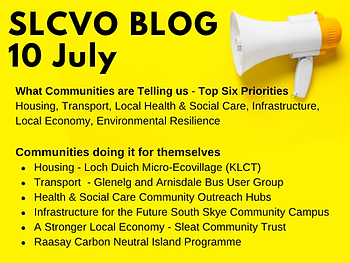
This week's blog looks at six inspiring community-led initiatives that are helping to meet the needs and aspirations identified by local people through the many area plans, place plans, community action plans and thematic reports developed across Skye and Lochalsh.
What Communities are Telling Us
Across Skye and Lochalsh, communities have spent recent years developing local place plans, community action plans, development strategies and thematic reports. From Broadford to Portree, Raasay to Sleat, Dunvegan to Lochalsh, residents have been identifying what matters most to them and setting out clear visions for the future.
What is striking when reviewing these plans is not how different communities are, but how similar their priorities are.
Despite the diversity of communities across the area, the same messages emerge time and again. Communities are telling us what they need to thrive, and those needs are remarkably consistent.
The growing number of community-led plans demonstrates both the commitment and capacity of local people to shape the future of their places.
Recent plans and community-led initiatives include:
SARF Skye & Raasay Area Place Plan Skye and Raasay Future (SARF)
Wester Ross, Strathpeffer & Lochalsh Area Plan WRSL Area Place Plan
Alongside these sit a growing body of evidence from organisations including:
Skye and Lochalsh CAB Up in Smoke: Fuel Focus | Skye & Lochalsh
Skye Climate Action Healthy Homes report published | Skye Climate Action
Staffin Community Trust https://skyeecomuseum.co.uk/why-staffin
Minginish Community Association https://minginishhall.co.uk/projects.html
Kilmuir Community Trust https://www.urraschillemhoire.co.uk/
Edinbane Community Company https://edinbaneandcommunitiescompany.org
Portree and Brase Community Trust https://www.portreeandbraes.org
Glendale Trust https://theglendaletrust.org/
Elgol and Strathaird Development Trust Facebook
Sleat Community Trusts https://www.sleat.org.uk/project_category/our-projects/
While each plan reflects local circumstances and local ambitions, together they paint a powerful picture of the challenges and opportunities facing the area.
Six Consistent Community Priorities
Across all the plans reviewed, six overarching themes repeatedly emerge.
Affordable housing that allows people to live and work in their communities
Housing is consistently identified as one of the most pressing issues facing communities. Many plans highlight concerns about:
A shortage of affordable homes for local people
Rising house prices and private rents
The impact of second homes and short-term lets
Difficulties recruiting and retaining key workers
Young people leaving the area due to limited housing options
Communities recognise that without action on housing, efforts to sustain schools, local services, businesses and vibrant communities become increasingly difficult. Housing is seen not simply as a property issue, but as fundamental to the long-term sustainability of communities.
Better Transport and Access to Services
Transport challenges are a common theme across communities throughout Skye and Lochalsh. Residents speak about:
Limited public transport options
High travel costs
Difficulties accessing services
Connectivity challenges for remote communities
Barriers faced by older people, young people and those without access to private vehicles
Improving transport links is viewed as essential for reducing isolation, supporting employment, accessing healthcare and strengthening community connections.
Improved Health, Wellbeing and Social Care Support
Communities consistently place health and wellbeing among their highest priorities. Plans highlight the need for:
Improved access to healthcare
Better mental health support
Services closer to home
Support for carers
Responses to loneliness and social isolation
Stronger support for an ageing population
Many communities are increasingly exploring community-led approaches that promote prevention, social connection and wellbeing alongside traditional services.
Stronger, Connected and Resilient Communities
A recurring theme throughout community plans is the importance of local infrastructure, participation and connection. Communities want:
Stronger local organisations
More opportunities for volunteering
Better community facilities
Greater involvement in local decision-making
Continued support for community-led development
Residents understand that resilience comes not only from services and infrastructure but also from strong relationships, active citizenship and empowered communities.
Sustainable Local Economic Opportunities
Communities across Skye and Lochalsh are ambitious about creating a stronger local economy that enables people to live, work and thrive in their communities. Plans consistently highlight the importance of:
Diverse local employment opportunities
Support for local businesses and social enterprises
Sustainable tourism that benefits communities
Community wealth-building opportunities
Retaining young people and attracting working-age residents
Developing community-owned assets and enterprises
There is a clear desire for economic development that creates quality jobs, supports local entrepreneurship and ensures that more wealth generated within the area remains within local communities.
Meaningful Action on Climate Change and Environmental Resilience
Alongside economic development, communities recognise the need to protect and enhance the natural environment that makes Skye and Lochalsh unique. Plans frequently identify the importance of:
Renewable energy initiatives
Improving energy efficiency in homes and community buildings
Reducing carbon emissions
Climate adaptation and resilience planning
Protecting natural habitats and biodiversity
Encouraging sustainable travel and transport options
Supporting community-led environmental projects
Communities are seeking practical action that helps them respond to climate change while strengthening resilience to future environmental, social and economic challenges. There is a strong emphasis on ensuring that environmental sustainability and community wellbeing go hand in hand.
From Consultation to Collective Action
Perhaps the most encouraging message from all of these plans is that communities are not simply identifying problems—they are already developing solutions.
Across Skye and Lochalsh, residents are demonstrating a strong commitment to leading change, managing community assets, developing local projects and working in partnership with public agencies and third-sector organisations.
A Community-Led Solution for Housing - Loch Duich Micro-Ecovillage
One of the most exciting community-led developments in Lochalsh is the proposed Loch Duich Micro-Ecovillage at Ratagan and Saraig. Led by Kyle & Lochalsh Community Trust, the project emerged from local housing research which identified affordable homes as one of the area's most pressing challenges.
The proposal combines affordable housing with economic and community development. Plans include six affordable rental homes, woodland crofts, additional house plots, business units and community growing space, creating a development that supports both local residents and the wider economy.
What makes the project particularly significant is that it is community-owned. The Trust acquired the land through a Community Asset Transfer with Forestry and Land Scotland, supported by the Scottish Land Fund, and has shaped the proposals through extensive community consultation.
The project has now progressed into the design stage, with sustainable housebuilder MAKAR appointed to develop detailed plans for low-carbon, energy-efficient homes.
More than just a housing development, the Micro-Ecovillage aims to tackle several of Lochalsh's key challenges at once—providing affordable homes, helping retain local families and workers, supporting local businesses, promoting community ownership and delivering climate-friendly development. It is a powerful example of a community identifying a need and taking action to create its own long-term solution
Glenelg and Arnisdale Bus User Group Connecting Communities
When communities talk about the importance of access to services, few examples are as compelling as the work of the Glenelg and Arnisdale Bus User Group (BUG). Operating in one of the most remote parts of our area, the charity exists to ensure that local people remain connected to essential services, public transport and opportunities beyond their immediate community.
BUG became a registered Scottish charity in March 2016 and was established specifically to advance community development through the provision of community transport within the remote communities of Glenelg and Arnisdale. Since then, it has played a vital role in reducing isolation and helping residents maintain their independence.
The charity operates two key transport services. The first is a subsidised on-demand taxi service that connects residents with the wider transport network at Shiel Bridge, providing access to Citylink services and onward travel. The second is a weekly community bus service linking residents with Kyle of Lochalsh, the nearest service centre, where people can access shopping, healthcare, banking and other essential services.
For many rural residents, particularly older people, those without access to a car and people with health conditions, these services are more than just transport. They provide a vital link to healthcare appointments, shops, community activities and social connections. According to the charity, its work helps reduce loneliness and isolation while improving wellbeing and community resilience.
The subsidised taxi scheme demonstrates how practical, community-led solutions can overcome the challenges of rural geography. Supported by Highland Council, the service connects Glenelg, Arnisdale and Corran with the main transport route at Shiel Bridge, allowing passengers to complete journeys that would otherwise be difficult or impossible using public transport alone. For a £5 voucher, residents and visitors can access a journey of up to one hour, helping maintain connectivity in an area where traditional transport services are limited.
The Glenelg and Arnisdale Bus User Group is a powerful example of community action responding directly to local need. In an area where distance and geography can present significant challenges, the charity helps ensure that residents remain connected to services, opportunities and each other. Its success demonstrates that community resilience often comes from simple but effective solutions designed and delivered by local people who understand the realities of living in remote rural communities
Find out more https://bug-voucher.co.uk/
Community Outreach Hubs, Bringing Services Closer to Home
A key priority identified across Skye and Lochalsh is improving access to health, wellbeing, welfare and social care services. In response, local organisations have developed the Skye and Lochalsh Community Outreach Hubs, bringing a wide range of support directly into communities through regular events held in local village halls. The initiative was developed in response to priorities identified through community engagement and local plans, which highlighted the need for more accessible, locally delivered services.
The Outreach Hubs operate as a one-stop shop for support, making it easier for people to find the help they need in a single location. Residents can access welfare and benefits advice, mental health support, counselling, family services, cost-of-living support, wellbeing activities and information from a range of organisations, all under one roof. By bringing services together in familiar community venues, the hubs provide a welcoming and accessible way for people to connect with support close to home.
This community-led approach helps remove many of the barriers that can prevent people from seeking support, including confusion about where to go, the need to contact multiple organisations and the challenge of navigating complex services. Instead, people can speak directly to different providers in one place, making support more visible, connected and easier to access.
While the primary focus is on bringing services to people's doorsteps, the project also recognises that some residents may still face challenges getting to local venues. To ensure the hubs are accessible to as many people as possible, free transport is available for those who need it.
The Community Outreach Hubs are a powerful example of how communities can work together to deliver services differently, creating support that is local, connected, easy to access and built around the needs of the people who use it.
Find out more https://www.slcvo.org.uk/community-hubs
South Skye Community Campus, Infrastructure for Future Generations
A recurring theme across community plans is the need for stronger community infrastructure, better facilities and more opportunities for people to participate in community life. The South Skye Community Campus is an excellent example of how communities can come together to turn these aspirations into reality. Developed by local volunteers and community organisations, the project aims to create, enhance and maintain sporting, leisure, recreational and creative facilities that will serve communities across South Skye for generations to come.
The vision for the Campus extends far beyond a single facility. Working alongside the development of the new Broadford Primary School, the project will create a community-managed campus that includes a floodlit all-weather sports pitch, a community games hall, upgraded village hall facilities, a multi-use games area, play facilities and future recreational developments such as a changing pavilion and bike pump track. The community will also manage the school's community wing outside school hours, ensuring these assets remain available and accessible to local people throughout the year.
What makes the project particularly powerful is the level of community involvement behind it. Over more than a decade, local residents, sports clubs, youth groups, the community council, parent council, Broadford and Strath Community Company and many volunteers have worked together to shape and drive the vision forward. Significant funding has been secured through community fundraising, partnership working and external investment, demonstrating what can be achieved when communities share a common goal.
The Campus is about much more than sport. It has been designed to create opportunities for learning, creativity, recreation and social connection. By providing welcoming spaces where people can come together, participate in activities, volunteer and build relationships, the project will help strengthen community cohesion, improve health and wellbeing and create greater opportunities for people of all ages to become involved in community life.
The project also responds directly to a challenge identified in many local plans: ensuring that growing communities have the infrastructure needed to support them. As South Skye continues to grow, local people recognised that investment in community facilities was essential to retain families, support young people and create places where people want to live and work. The Campus provides a lasting community asset that will help meet these needs while giving local people greater ownership and influence over the facilities and opportunities available in their area.
The South Skye Community Campus demonstrates that community resilience is built through more than services and buildings. It is created when people work together, volunteer their time, take ownership of local challenges and invest in the future of their communities. As such, it stands as one of the strongest examples of community-led development currently underway in Skye and Lochalsh.
Find out more https://www.southskyecampus.org/
Sleat Community Trust: Building a Stronger Local Economy
Since its formation in 2003, the Sleat Community Trust has focused on supporting sustainable economic, environmental and social development through community ownership and local enterprise.
A key part of the Trust's success has been its ability to create and manage businesses that meet local needs while generating income that can be reinvested back into the community. One of the most visible examples is Armadale Stores, the community-owned shop, post office and fuel station. As well as providing essential services for residents and visitors, the business supports local employment and helps ensure that spending remains within the local economy. Rather than profits leaving the area, income generated by the business contributes to community priorities and future development opportunities.
Recognising that strong digital infrastructure is essential for modern rural communities, the Trust also developed Skyenet Community Broadband. Reliable internet access enables people to work remotely, run businesses, access education and stay connected with services. By investing in community broadband, Sleat Community Trust has helped create the conditions for local businesses to grow while making the area a more attractive place for families and working-age residents.
The Trust has also demonstrated how communities can benefit directly from the transition to a greener economy. Through Sleat Renewables, community-owned renewable energy projects generate income that can be reinvested into local priorities. This not only contributes to environmental sustainability but also creates a long-term funding source that helps support future community projects and development ambitions.
Alongside its commercial enterprises, the Trust continues to invest in community assets such as Tormore Forest. Projects like this provide environmental, recreational and future economic benefits while ensuring that local people have a greater say in how community resources are managed. Community ownership allows decisions to be guided by local priorities, helping balance economic opportunity with environmental stewardship and community wellbeing.
What makes Sleat Community Trust such a strong example of sustainable local economic development is the way its projects work together to create lasting community benefit. Through local businesses, renewable energy, digital infrastructure and community-owned assets, the Trust is creating jobs, supporting entrepreneurship, retaining wealth within the area and helping build a more resilient local economy. At a time when many communities are seeking ways to attract and retain residents, support local businesses and create sustainable growth, Sleat demonstrates the power of community ownership to deliver long-term economic success
Find out more https://www.sleat.org.uk/
Raasay Carbon Neutral Island Programme
Communities across Skye and Lochalsh are increasingly taking practical action to address climate change while protecting the natural environment and strengthening local resilience. One of the strongest examples of this is the Raasay Carbon Neutral Island Programme, which has placed the community at the centre of planning for a more sustainable future. The programme is led by Raasay Development Trust and has been shaped through extensive community engagement, ensuring that local people are directly involved in identifying priorities and solutions.
The resulting Raasay Community Climate Change Action Plan sets out a long-term vision for reducing carbon emissions, improving sustainability and building resilience to future environmental challenges. The plan focuses on a range of priorities that are echoed across community plans in Skye and Lochalsh, including renewable energy, sustainable transport, energy-efficient housing, climate adaptation and community resilience. It reflects a recognition that climate action is not just an environmental issue but one that affects housing, transport, the local economy and community wellbeing.
A key feature of Raasay's approach is its commitment to community-owned renewable energy. Through Raasay Community Renewables, local residents have developed and operate community-owned hydro schemes that generate clean electricity and deliver benefits back to the community. This approach not only reduces carbon emissions but also helps retain wealth locally, creating a more sustainable and resilient local economy.
The Carbon Neutral Island Programme has also examined the island's carbon footprint through community surveys, energy audits and transport assessments. This evidence is being used to identify practical actions to improve energy efficiency in homes, reduce dependence on fossil fuels and support more sustainable travel options. By basing decisions on local data and community priorities, the programme is helping ensure that climate action delivers tangible benefits for residents.
Importantly, the programme recognises that climate resilience involves more than reducing emissions. It also includes preparing communities for future environmental and economic challenges, protecting natural assets and ensuring that communities are better able to adapt to change. Through its focus on sustainable land use, renewable energy, housing, transport and community engagement, Raasay is demonstrating how environmental sustainability and community wellbeing can go hand in hand.
The Raasay Carbon Neutral Island Programme provides a powerful example of community-led environmental action. Rather than waiting for solutions to be delivered from elsewhere, the community has taken ownership of the challenge, developed a shared vision and is actively working towards a more sustainable future. In doing so, it demonstrates how communities can respond to climate change while creating local economic opportunities, strengthening resilience and protecting the environment for future generations
Find out more https://raasay.com/carbon-neutral-islands/
Blog produced with the support of Microsoft Copilot


Comments