Forum Notes 18 March

This month’s Forum focused on children’s and young people’s services. Members from Mikeysline, The Highland Council, Lochalsh and Skye Housing Association, Public Health Scotland, and SLCVO explored a number of issues that have emerged over recent months and began working together on ways we can collectively address them.
If you would like to find out more about the Forums or register for the next one, please visit: https://www.slcvo.org.uk/community-wellbeing-and-support-forum
Overview: Children & Young People’s Services in Highland
Children’s services across Highland are shaped and delivered through the Highland Children’s Service Plan 2023–2026, jointly led by NHS Highland and The Highland Council. This plan sets the strategic direction for all statutory services for children and young people, ensuring provision is high‑quality, trauma‑informed, joined‑up, and preventative.
Key public‑sector partners include:
NHS Highland – health visiting, school nursing, child mental health support, specialist health services, early years health pathways.
The Highland Council – education, ASN support, youth work teams, social work, early years settings, family support.
Community Planning Partnership agencies – such as police, housing, and public health, working together to tackle inequalities and improve outcomes.
These services are guided by Scotland’s Children and Young People (Scotland) Act 2014, GIRFEC principles, and commitments under The Promise, aiming to ensure that all Highland children are Safe, Healthy, Achieving, Nurtured, Loved, Respected and Included (SHANARI)
The Integrated Children’s Service Planning Board (ICSPB) oversees delivery, supported by strategic groups such as the Child Protection Committee, The Promise Board, Poverty Group, Rights and Participation Group, and the Health & Wellbeing Board. These groups work through a life‑course approach to ensure coordinated support at every stage.
Third‑Sector Roles Across Highland
The third sector plays a central role, working alongside public agencies to reach families earlier, bridge gaps, and provide flexible community‑based support. Third‑sector contribution is embedded within the Children’s Service Plan and shaped by the Joint Strategic Needs Assessment. Examples include:
Care and Learning Alliance (CALA) – early years support, training, e‑learning and contributing facilitators to GIRFEC implementation.
Mikeysline – youth mental health support and digital/text helplines.
Housing associations & community development trusts – supporting family wellbeing, access to safe housing, and addressing rural isolation.
The third sector is also essential in the development of the Children & Young People’s Participation Strategy, which was co‑designed with more than 800 young people across Highland.
Connecting to Community Groups in Skye and Lochalsh
Skye and Lochalsh benefit from the same strategic frameworks as the wider Highland region, but the delivery is very much localised and community‑led, relying on strong third‑sector partnerships and small grassroots organisations.
Grassroots groups connect into the Highland-wide system in three key ways:
Through Community Partnerships and participatory processes like the Voice Process, grassroots groups can raise local neds relating to young people—whether that’s mental health pressures, transport barriers, or cost‑of‑living impacts—and feed these into the wider planning structures.
Local grassroots groups play a vital role in supporting children, young people, and families across Skye and Lochalsh. Organisations such as Portree Youth Club, Cool Scotland, Skye & Lochalsh Young Carers, Counselling Care Skye and Lochalsh, Skye Youth Pipe Band, Lochalsh Junior Football Club, and SkyeDance all contribute to the wellbeing of young people by offering:
Activities and safe spaces where young people can socialise, build confidence, and develop skills
Early help and informal family support, providing a friendly first point of contact for parents and carers
Signposting to mental health, financial wellbeing, housing and other support services
Partnership work with local schools, health visitors, and other professionals
These groups act as essential “first responders” for low‑level needs, helping to identify concerns early and prevent issues from escalating. Their work directly aligns with the Highland Children’s Service Plan, which places strong emphasis on prevention, early intervention, and trauma‑informed practice.
Participating in local multi‑agency forums and partnership events such as the Skye and Lochalsh Health, Wellbeing, Welfare and Social Care Collaboration. These spaces bring together the third sector, NHS Highland, and The Highland Council to share insights from frontline work, identify gaps in local provision and improve the overall experience of young people accessing services. This collaborative approach reflects the Highland system’s expectation for joined‑up, high‑quality services across sectors, ensuring that families experience consistent support no matter which doorway they enter.
For more information on Highland plans and initiatives visit
Highland Children’s Service Plan 2023 – 2026 Child Health – Who are we?
Children's Services - Highland Community Planning Partnership
Children's Rights & Participation website Children's Rights and Participation Highland
Children's Rights and Participation Highland - Children & Young People's Participation Strategy
Highland Children and Young People’s Needs Assessment CYP-JSNA-1.pdf
Forum Conversations
The Forum opened with an overview of the Skye and Lochalsh Community Outreach Hub project, an initiative developed through the HWWS Collaboration. Funding has now been secured for two years, allowing community hubs to be delivered across the area.
These hubs aim to bring services closer to families, reduce travel barriers, and create supportive spaces where people can connect with professionals and each other.
A key feature of the new hub model is a morning play session for children, hosted by Corry Capers. These sessions are free, but booking is required in advance to ensure a safe and calm environment for little ones.
The purpose of the children’s play session is to give parents and carers dedicated time to speak confidentially with the services available in the hall, such as:
SLCAB (Citizens Advice)
Connecting Carers
Employability services
and other visiting partners
This approach helps families access support without needing separate childcare or extra travel.
Corry Capers is an outdoor learning programme run by Broadford & Strath Community Company. Their work takes place in the woodland beside the Growers Hub in Broadford, where they deliver high‑quality after‑school and holiday childcare rooted in nature, creativity, and hands‑on rural skills. Activities include woodland play, den‑building, exploring nature, and creative outdoor crafts, all designed to support confidence, wellbeing, and imagination.
Corry Capers will be bringing their unique blend of outdoor play, rural skills, and nature‑based learning into the Outreach Hubs, offering families in Skye and Lochalsh a taste of the woodland experience in a warm, indoor setting.
Find out more about Corry Capers:
Keep up to date with their latest activities on Facebook: https://www.facebook.com/corrycapers/
Increasing use of Nicotine pouches
With the integration of the Drug and Alcohol Forum into the HWWS Collaboration, several issues raised over recent meetings now sit within the Children and Young People’s Community Wellbeing and Support Forum. One of the most pressing topics is the growing use of nicotine pouches among young teens, first highlighted by the Youth Development Officer for Skye and Raasay. During discussions, everyone around the table noted that they too had seen this rise locally, and there was agreement that more information needs to be made available to parents, alongside coordinated local action to reach young people and raise awareness of the harm these products can cause.
Nicotine pouches are small white packets placed between the gum and upper lip, allowing nicotine to be absorbed directly through the mouth. They produce no smoke, vapour or smell, which makes them easy to hide from parents, carers and teachers. They are sold in sweet or minty flavours, which increases their appeal to young people, and although they do not contain tobacco leaf, they do contain nicotine, meaning children and teens can become addicted very quickly.
ASH Scotland has produced a comprehensive online briefing explaining the difference between nicotine pouches and snus, outlining the health risks, and providing UK‑wide prevalence data.
This resource can support both professionals and parents to better understand the issue. https://ashscotland.org.uk/briefing/nicotine-pouches/
NHS Highland’s Smoking Cessation Team will soon be supporting this work locally. Kate Hathway, the new advisor for the area, will join the Outreach Hubs from April and is available by email at kate.hathway@nhs.scot or by phone on 07768 100 022. Families and professionals can also find information and support on the Smoke Free Highland website: www.smokefreehighland.scot.nhs.uk.
Going forward, the forum will work alongside the Youth Development Officer, NHS Highland, Planet Youth, and local groups to increase awareness around nicotine pouches, vaping and smoking, and to ensure young people, parents and practitioners have access to up‑to‑date information and support. Some suggestions include;
Adopting the successful approach My Future Fridays programme used in the Careers Talks but with a focus on health and wellbeing.
Working with the Personal and Social Education (PSE) classes in schools, a curriculum area focused on supporting pupils' personal, social, and emotional development, fostering health, wellbeing, and citizenship.
Connecting with the local police team to identify any places where young people may be purchasing these products, and then working with those businesses to promote awareness of the associated harms.
Planet Youth in Lochalsh and Skye
Planet Youth Highland is an NHS Highland–led initiative that uses the Icelandic Prevention Model, a proven, community‑driven approach designed to reduce youth substance use and improve young people’s wellbeing. The programme works with local partners and uses anonymous youth surveys to understand real experiences, identify risks, and strengthen the protective factors around young people.
In Lochalsh, Planet Youth is working closely with Plockton High School and has established a Local Community Action Group. This group reviews local survey findings and develops tailored action plans to support young people in ways that reflect the needs of the community.
Although the core work is based in Plockton, all resources are available to anyone across Highland, and families or groups can easily access more information — including links to key resources — through their Linktree. https://linktr.ee/planetyouthinhighland
Life Skills Development
The forum discussed the growing need for basic life‑skills support for young people, particularly those leaving education early and preparing to live independently. Key areas identified included budgeting, how to apply for housing, completing essential forms, and obtaining a National Insurance number. While it was acknowledged that online guidance exists, many young people require one‑to‑one support to understand these processes and build confidence. It was suggested that creating a practical information pack, including key forms and step‑by‑step guidance, would be extremely helpful for support workers working directly with young people.
The forum agreed to explore what resources already exist and how these could be brought together in a format that is easy to use in direct support work. As a first step, SLCVO will speak with local social work teams, either through a team meeting or a dedicated workshop, to map out needs and gaps in the area. This will follow a similar approach to the Adult Social Care “Gaps in Services” workshop held in November last year.
Project Update: Alternative Education Opportunities
Some children and young people in Skye and Lochalsh face barriers in education, including difficult transitions, limited support for additional needs, and challenges linked to rural living. The aim of the alternative education opportunities project, led by local Social Work, was to explore how local organisations could work with Education services to create flexible learning opportunities and make better use of existing community assets. This approach has already been successful elsewhere in Highland, with similar partnerships between Education and third‑sector organisations—such as the Highland Boxing Academy and the Scottish Fire and Rescue Service.
There was strong support from local third‑sector and private‑sector organisations; however, the local Education team have other support routes they are using. Because of this, the project is on hold and remains at the concept stage within the HWWS collaboration. However Columba 1400 is still seeking funding to deliver activities for local children and young people and is working with the local Social Work team.
We will keep the concept active and revisit it when circumstances allow.
Dates of Next Forums
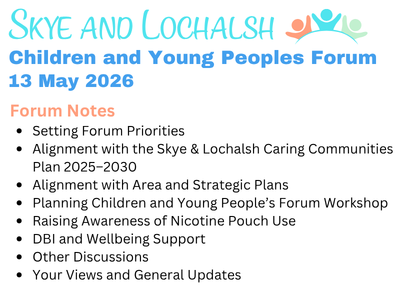
13 May - Hybrid, Portree UHI 1.30 – 2.45
19 August - Hybrid, Broadford UHI 1.30-2.45
18 November - Hybrid, Portree UHI 1.30 – 2.45
See https://www.slcvo.org.uk/forum-registration for more information


Comments